
How it works
How a solar panel cleaning tractor works
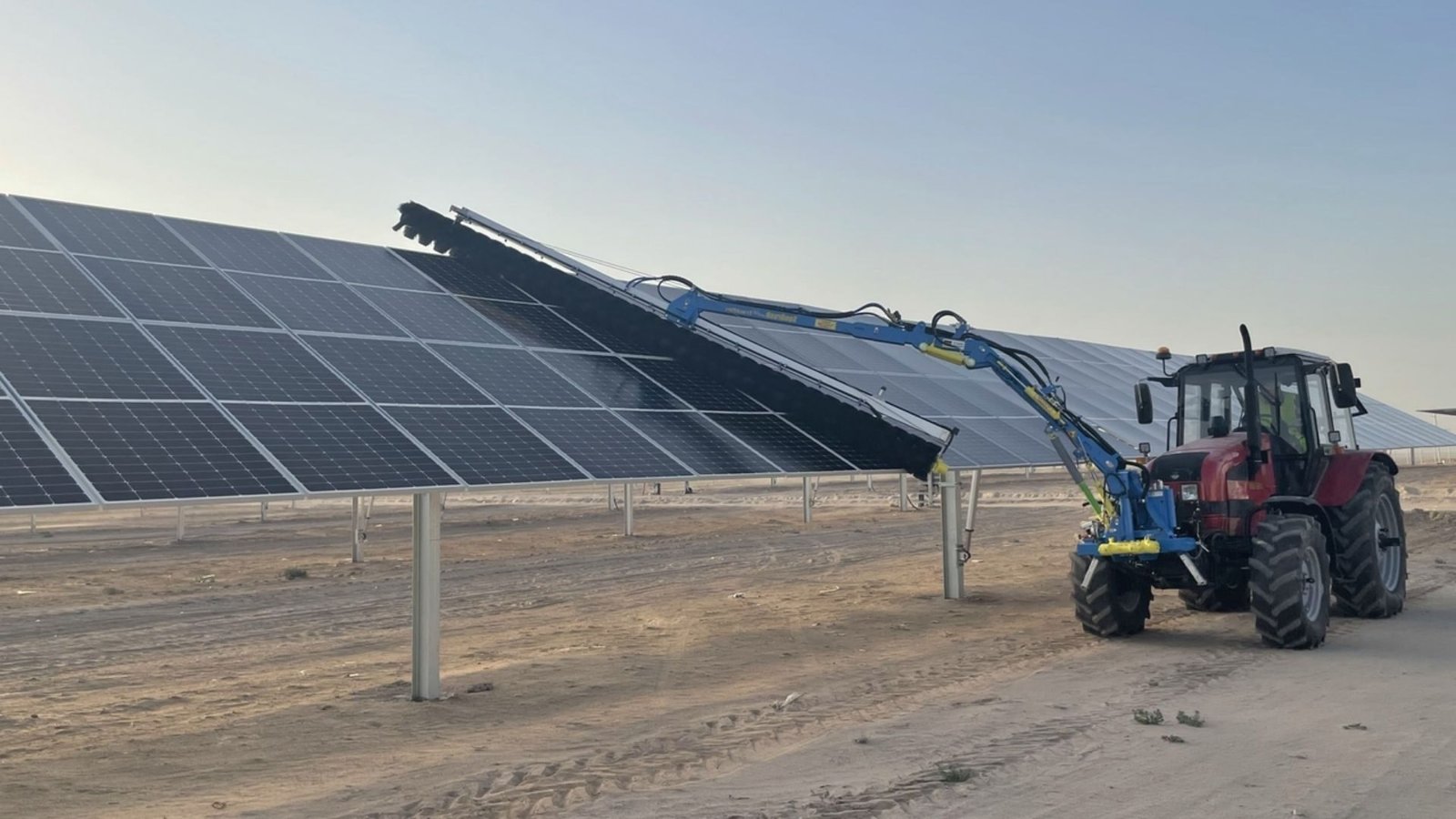
A hydraulic boom, a rotating soft brush and a measured water spray, all powered by the tractor. One operator drives along the row and cleans the table in a single pass.
On site
A cleaning run, step by step
- 1
Unfold and position
At the start of the row, the operator unfolds the boom with the hydraulic levers and swings it to the side being cleaned.
- 2
Set the brush on the table
The free-pivoting head settles at the panel angle. There is no height or angle setting to repeat for each row.
- 3
Start water and brush
Water from the 1,000-litre tank is sprayed at the turning brush. For light, loose dust the brush can run dry.
- 4
Drive along the row
The tractor moves at 0.25–2 km/h. Slower speeds suit heavy soiling and faster speeds suit routine dust.
- 5
Turn and clean the next side
At the row end, the boom swings across (up to 120°) to clean the opposite row on the way back.
- 6
Fold, rinse and park
After the shift, the boom folds along the right side for transport. The service hose rinses the brush and tractor.
Inside the system
Four systems working together
Hydraulics
106 LPM hydraulic flow, a 150-litre oil tank, four hydraulic jacks and two 3-spool directional control valves drive the boom and brush.
Brush
A 14 in spiral, soft-bristle brush in 15 ft or 26 ft lengths, on a head that moves through up to 270°.
Water
A 1,000-litre tank on a rear pallet-fork frame feeds the spray at the brush and a 10 m service hose.
Lighting
Two front focus lights, four roof LEDs, an under-chassis lamp and a cabin light for safe night work.
Panel care
Good practice for safe, effective cleaning
- Clean in the early morning, evening or at night, when modules are cool and generation is low
- Use clean water with low mineral content; filter muddy sources
- Keep spray pressure low; the brush, not the water jet, does the cleaning
- Never apply extra force to the brush head
- Avoid detergents; plain water and a soft brush are enough for routine soiling
- Follow your module maker’s cleaning guidelines
Planning
What to check before the machine arrives
| Item | Why it matters |
|---|---|
| Row spacing and road width | The tractor and folded boom must pass between rows and along internal roads. |
| Lowest and highest panel edge | The J-series covers panel heights from 1 to 10 ft. |
| Table width | Sets the brush length: 15 ft or 26 ft. |
| Water source and filling point | At about 4,000 L per MW, the 1,000-litre tank needs refilling roughly every 0.25 MW. |
| Obstacles in the row | Cables, junction boxes and posts near the module edge need clearance. |
FAQs
Operating questions
Can it clean without water?
Light, loose dust can be brushed dry. Water is recommended for bird droppings, pollen and caked soiling, and gives a more even finish.
How fast does it clean?
The spec sheet lists about 0.4 MW per hour at a working speed of 0.25–2 km/h. Real output depends on row length, turning space and how dirty the panels are.
When is the best time to clean?
Early morning or late evening, when generation is low and the glass is cool. The lighting kit also allows night shifts, which avoids thermal shock from cold water on hot modules.
Can it clean panels on single-axis trackers?
The free-pivoting brush follows the panel angle, which helps on trackers. Share your tracker make and stow angle so we can confirm clearance before you order.
Talk to an engineer
See it working on your rows
Tell us about your plant and we will arrange a discussion with our team.