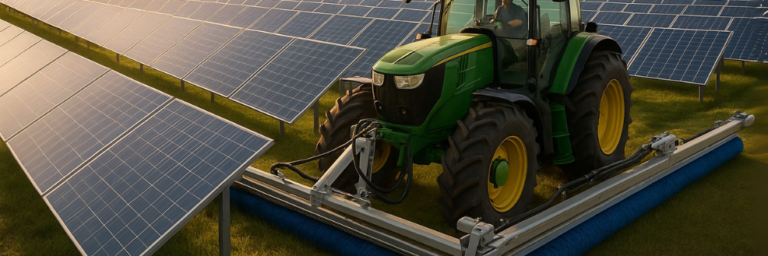
11 Sep 2025
Deploying Solar Panel Cleaning Tractors in Mega Solar Parks: A Practical Guide
Mega solar parks run to hundreds of megawatts across thousands of acres. At that scale, cleaning has to be planned like any…
Read the guideTractor-mounted solar panel cleaning systems · Chennai, India

Tractor-mounted PV cleaning · Built in Chennai
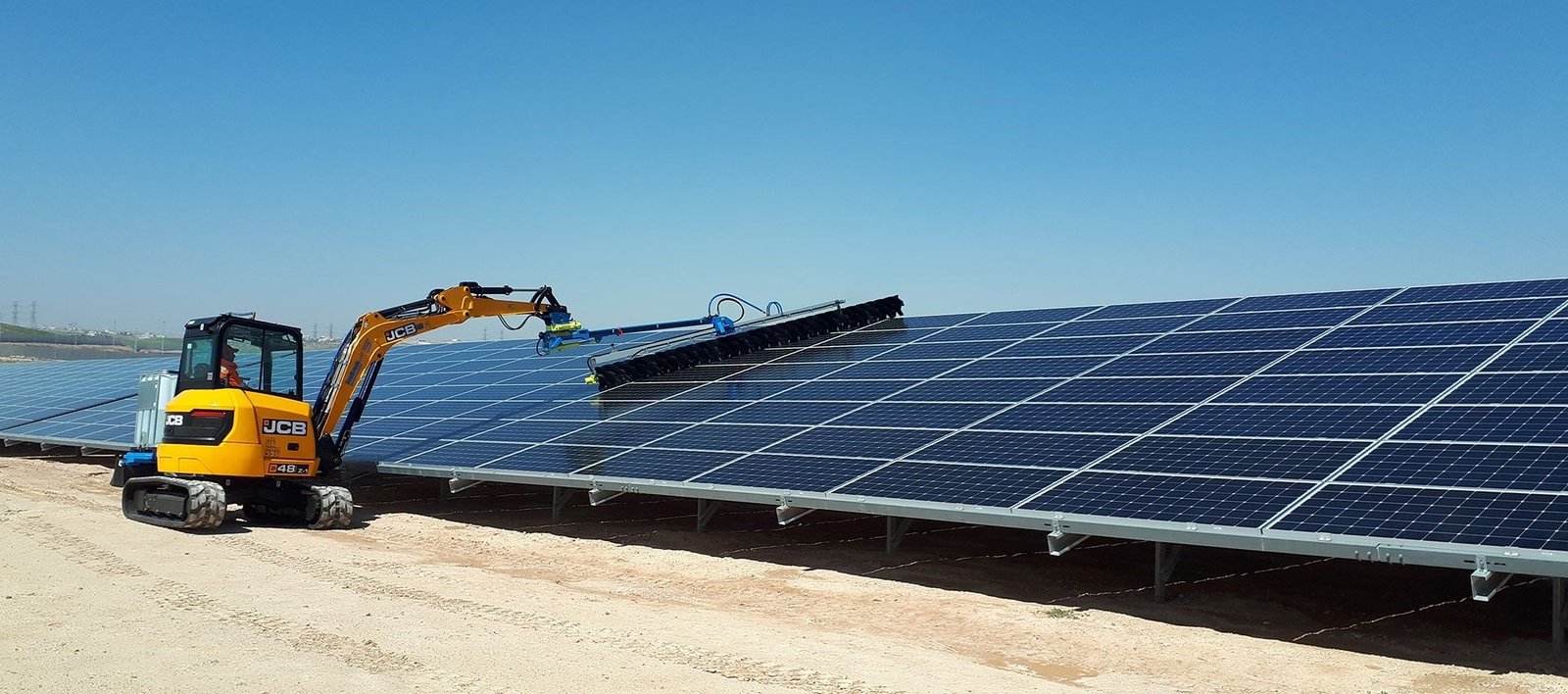
Dust and bird droppings cut the output of every solar plant. Our J-series cleaning systems mount on a 30–75 HP tractor, so one operator can clean about 0.4 MW per hour with a soft-bristle brush and measured water.
See how long a cleaning cycle takes for your MW, and how much water it needs.
Open the planner
Mechanise cleaning across several sites with one trained operator per machine.
O&M use
Add a cleaning boom to the tractor you already run, without modifying it.
Fit my tractor
Installation, operator training, annual maintenance and spare brushes.
Service and support
The problem
Dust, pollen and bird droppings form a film that blocks sunlight from reaching the cells. In dry, dusty regions the loss builds week by week, and a single bird dropping can shade a cell enough to drag down the whole string.
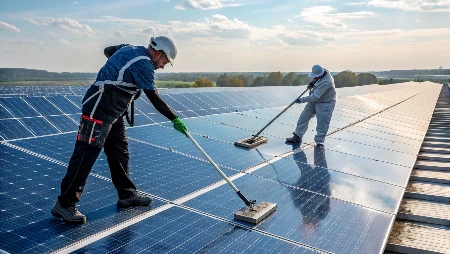
Manual crews with buckets and poles struggle to keep up on a large plant. Cleaning is slow, water use is hard to control, and quality varies from row to row and shift to shift.

How it works
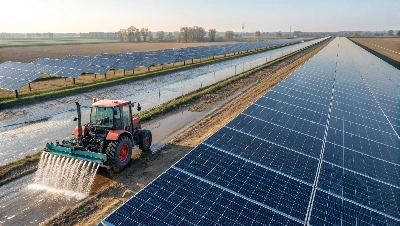
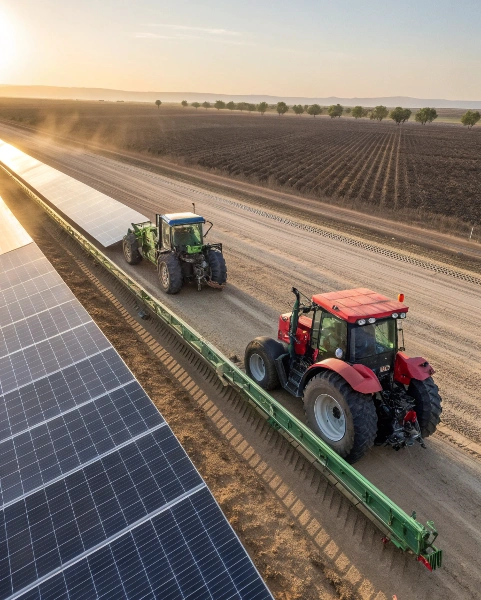
The cleaning system bolts onto the tractor and runs from its hydraulics. The operator drives along the row while the brush and water do the work.
A 14 in spiral soft-bristle brush, 15 or 26 ft long, turns on a 120° swivel boom. The head pivots freely to follow the panel angle.
Water from a 1,000-litre tank is sprayed at the brush. Light dust can be brushed dry; water lifts droppings and caked soil.
Hydraulic drive from the tractor means no separate engine or generator. The boom folds alongside for transport.
Models
Nine configurations for 30 to 75 HP tractors, with 15 ft or 26 ft brushes and optional grass cutters.
30 HP · 15 ft brush
The J3: the compact option, with a 15 ft brush on a 30 HP tractor.
View specifications
45 HP · 15 ft brush
The J4: a 15 ft brush on a 45 HP tractor, a balance of reach and manoeuvrability.
View specifications
50 HP · 15 ft brush
The standard J1 set-up: a 15 ft spiral brush on a 120° swivel boom, run from a 50 HP tractor.
View specifications
50 HP · 26 ft brush
A 26 ft brush for wide tables and double-row structures, on a 50 HP tractor.
View specifications
35 HP · 15 ft brush · grass cutter
The J2: a 15 ft brush and a grass cutter on a 35 HP tractor.
View specifications
75 HP · 26 ft brush
The heavy-duty option: a 26 ft brush with the headroom of a 75 HP tractor.
View specifications
From the spec sheet
Figures from the J-series specification. Site output depends on layout, soiling and operator.
Why mechanise
One operator covers far more rows per shift than a manual crew, so every block gets cleaned on schedule.
Water is sprayed at the brush instead of poured over the glass. Plan on about 4,000 litres per MW.
The tractor you already run does the heavy work, with one trained operator instead of a large crew.
Constant brush speed and pressure give the same finish on every table, without missed strips.
A soft brush and plain water clean the modules, with no chemicals to run off into the soil.
Clean modules on a regular cycle keep output close to what the plant was designed for.
Applications
Service and support
Buying the machine is only the start. We set it up on your site, train your operators and keep it running.
Enter your plant size and number of machines to see cycle time, water per cycle and tank refills.
Why Solar Tractors
J-series systems are built under the Synergy Rigs brand, with parts and service close at hand.
Brush length, tractor class and grass cutter are matched to your table width and terrain.
We understand tractors and hydraulics as well as PV modules and plant operations.
Operator training, spare brushes and maintenance contracts keep machines working.
FAQs
It is a tractor fitted with a hydraulic boom and a rotating soft-bristle brush. The operator drives along the row while the brush and a water spray clean the modules, so one person can clean far more panels per shift than a manual crew.
Our J-series models are set up for 30, 35, 45, 50 and 75 HP tractors. The system mounts externally, so the tractor is not cut or welded. Send us the make, model and HP and we will confirm the fit.
Plan on about 4,000 litres per MW cleaned, from the J-series spec sheet. The 1,000-litre tank on the rear frame covers roughly 0.25 MW per fill.
The spec sheet lists about 0.4 MW per hour at a working speed of 0.25–2 km/h. Real output depends on row length, turning space and how dirty the panels are.
The brush is a spiral, soft-bristle design made for smooth PV glass, and the free-pivoting head stops it pressing into the modules. Use clean water and keep the brush free of grit.
Yes. We install and commission the system on site and train your operators on driving, boom handling, water settings and daily checks.
Guides
Practical reading on cleaning methods, water, schedules and O&M.
11 Sep 2025
Mega solar parks run to hundreds of megawatts across thousands of acres. At that scale, cleaning has to be planned like any…
Read the guide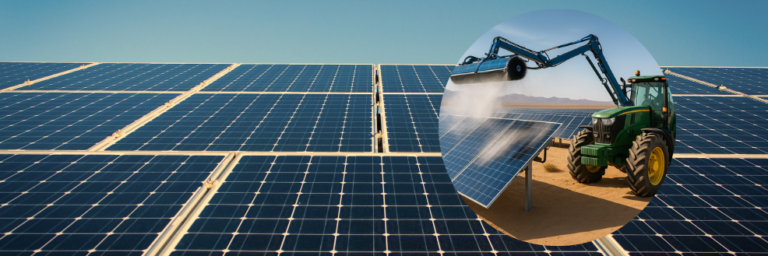
11 Sep 2025
Deserts and arid regions have some of the best sunshine for solar power and some of the hardest conditions for keeping panels…
Read the guide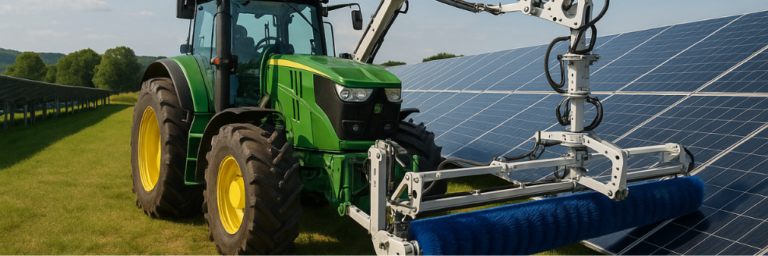
11 Sep 2025
Solar panel cleaning has moved a long way from buckets and squeegees. On large ground-mounted plants, tractor-mounted brush systems now do work…
Read the guideTalk to an engineer
Share your plant size, table width and tractor details. We will suggest a configuration and send a quotation.