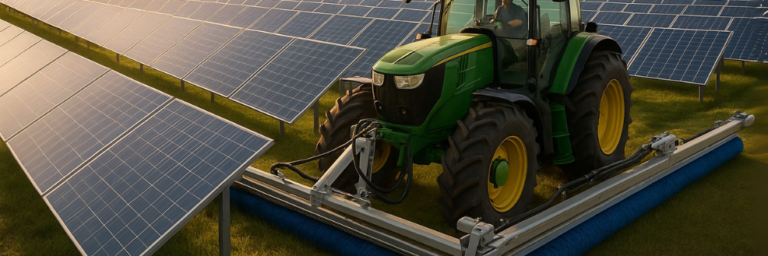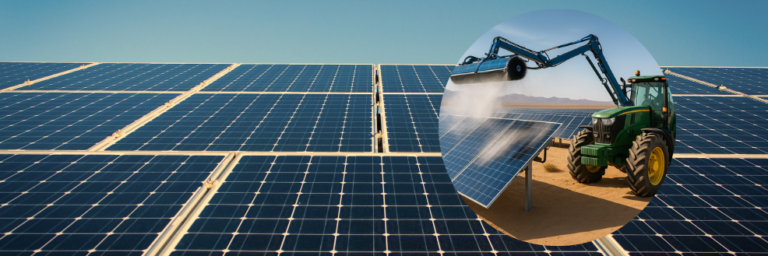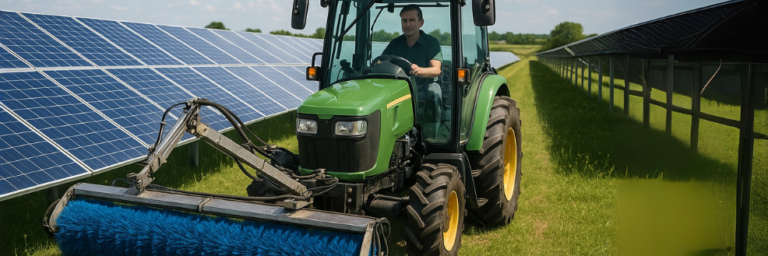
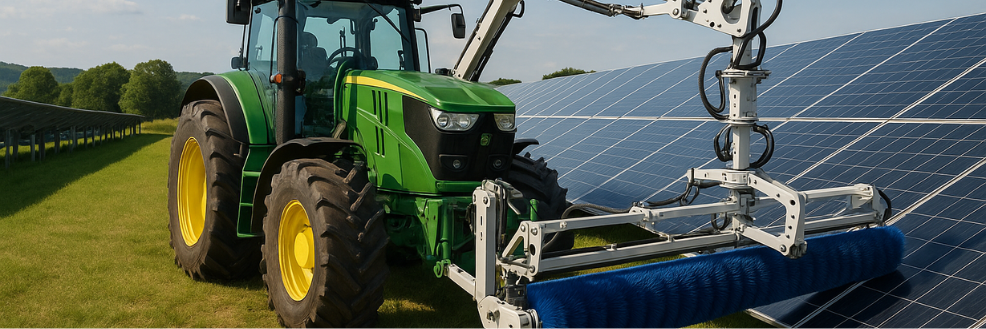
Solar panel cleaning has moved a long way from buckets and squeegees. On large ground-mounted plants, tractor-mounted brush systems now do work that once needed large crews. This article looks at the design ideas that make them effective, and where other technologies such as robots fit in.
From manual crews to mechanised cleaning
Manual cleaning is flexible but slow, and its quality depends on each worker. Mechanised cleaning brings repeatability: the same brush speed, the same contact and the same coverage on every table.
The ideas that make tractor-mounted cleaning work
Swivel booms
A boom that pivots from a central point can reach the rows on either side of the tractor. Our J-series boom swings up to 120°, so the operator cleans one side going out and the other coming back.
Free-pivoting brush heads
Instead of a fixed brush that must be set for each table angle, the brush hangs from a free pivot and settles at the panel angle on its own. It also rides over dips in the track without pressing into the glass.
Soft spiral brushes
Spiral bristle patterns sweep loosened dirt off the module as the brush turns. Soft bristles suit PV glass and its anti-reflective coating.
Measured water
Spraying water at the brush, rather than flooding the module, keeps consumption predictable. The J-series specification lists about 4,000 litres per MW, from a 1,000-litre tank on the rear frame.
Hydraulic power from the tractor
Driving the brush and boom from the tractor’s hydraulics removes the need for a separate engine or generator.
Lighting for night work
Front focus lights, roof LEDs and an under-chassis lamp allow cleaning before sunrise or after sunset, when modules are cool and no generation is lost.
Combined grass cutting
Some models add a grass cutter, so the same visit cleans the modules and cuts vegetation that would otherwise shade the lower edge of the panels.
Where robots and drones fit
Row-mounted robots can clean without an operator and suit uniform rows, especially where water is scarce. Drones help with arrays that are hard to reach from the ground. Tractor-mounted systems are strongest on large plants with drivable paths between rows. Many plants use a mix. Our comparison of cleaning methods sets out the trade-offs.
What to watch next
Across the industry, operators are adding better soiling measurement, data-driven cleaning schedules and guidance aids for drivers. The fundamentals stay the same: a soft brush, the right amount of water and a cleaning cycle matched to how fast your plant gets dirty.
Conclusion
The best cleaning systems are the ones that fit the site. If your plant has drivable rows, see our tractor-mounted models or ask for a recommendation.
Planning cleaning for a large plant?
Send your plant size, table width and tractor details. We will suggest a configuration and send a quotation.