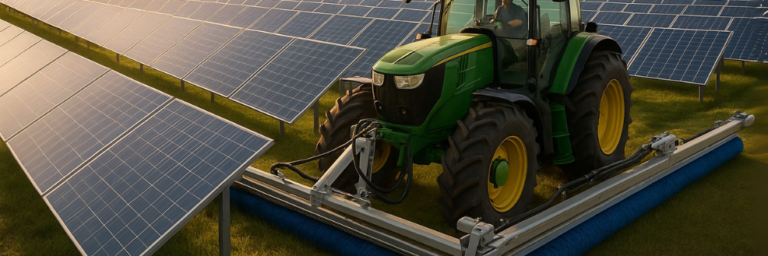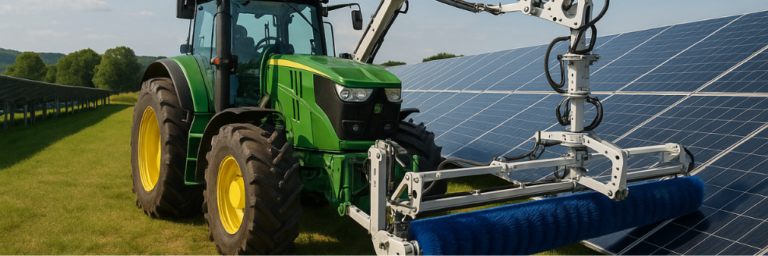
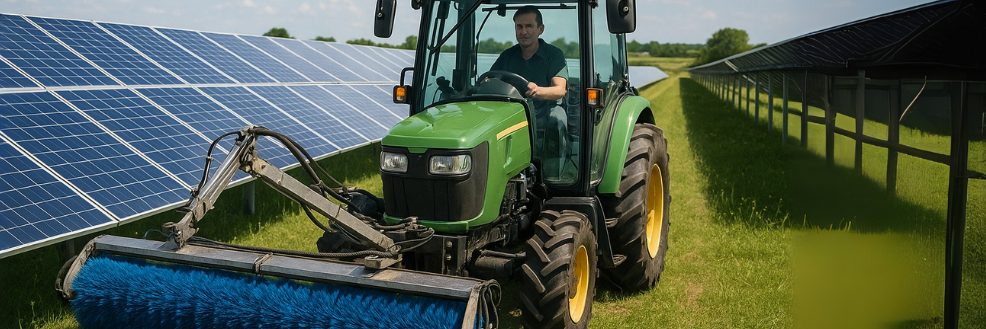
Every module on a solar plant produces less when it is dirty. The question for an owner or O&M manager is not whether to clean, but how to clean often enough, evenly enough and at a cost that pays back. This guide shows how a cleaning tractor affects both sides of that calculation.
How soiling reduces output
Dust, pollen and bird droppings form a film that blocks part of the light reaching the cells. The loss depends on location, season, rainfall and how long since the last clean. It can be small in the monsoon and significant in a dry, dusty season. Bird droppings matter more than their size suggests, because a shaded cell can pull down the output of a whole string.
The only reliable way to know your soiling loss is to measure it, for example by comparing a cleaned reference string with an uncleaned one, or by watching performance ratio before and after a cleaning cycle.
How a cleaning tractor improves yield
- Shorter cycles: at about 0.4 MW per hour per machine (J-series specification), a plant can be cleaned more often, so rows spend less time dirty.
- Even cleaning: a constant brush speed and a head that follows the panel angle leave no missed strips.
- Better timing: lighting allows night or early-morning shifts, so cleaning does not cost generation hours.
How it changes cleaning cost
- Labour: one operator per machine instead of a large crew.
- Water: about 4,000 litres per MW, sprayed at the brush instead of poured.
- Equipment: the system runs on a tractor’s hydraulics, so there is no separate engine to run and maintain.
Working out your own return
Use your own plant figures. The structure of the calculation is simple:
- Annual generation = plant size (MW) × capacity utilisation factor × 8,760 hours.
- Generation recovered = annual generation × the share of soiling loss that better cleaning recovers.
- Value recovered = generation recovered × your tariff.
- Net benefit = value recovered + labour and water saved − machine running costs.
Illustrative example
Take a 10 MW plant with a 20% capacity utilisation factor. It produces about 10 × 0.20 × 8,760 = 17,520 MWh a year. If more frequent, even cleaning recovers just 2% of that, the gain is about 350 MWh, or roughly 3.5 lakh units. At a tariff of ₹3 per unit, that is about ₹10.5 lakh a year, before counting labour and water saved.
These numbers are only an illustration. Replace them with your measured soiling loss, tariff and costs. The cleaning planner helps with cycle time and water.
What affects the result
- Local dust levels, rainfall and bird activity
- Row length, turning space and internal roads
- Water availability and quality
- Operator skill and maintenance of the brush
Conclusion
A cleaning tractor improves returns by making cleaning faster, more even and more predictable. Measure your soiling loss, run the numbers with your own figures, and talk to us about the configuration that fits your plant.
Planning cleaning for a large plant?
Send your plant size, table width and tractor details. We will suggest a configuration and send a quotation.